The 60-Second Rule: Why Speed to Lead Decides Who Wins
Speed to lead is the whole game: call inbound leads in under 60 seconds and win them before rivals dial. The data behind the 60-Second Rule.
June 7, 2026
Speed to lead is not a metric you glance at once a quarter. It is the whole game. The business that calls a new inbound lead first almost always wins it — not the one with the best price, the prettiest website, or the longest wall of reviews. So here is the rule the rest of this post is built on: call every inbound lead in under 60 seconds, or watch someone slower-but-faster-to-dial book the meeting you earned.
We call it the 60-Second Rule because that is the window where intent is still hot. A lead who just submitted your form is sitting there, phone in hand, three tabs open. Sixty seconds in, you are the company that picked up. Sixty minutes in, you are a voicemail.
Speed to lead is a decay curve, not a to-do item
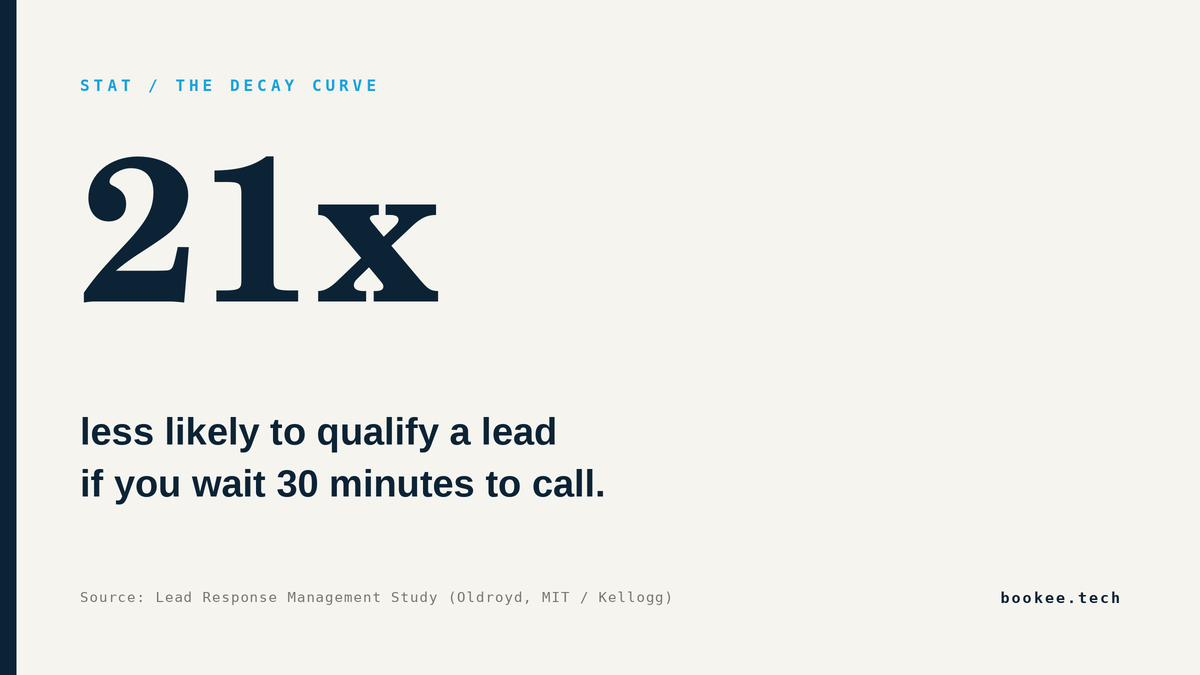
The research is not subtle. The widely cited Lead Response Management study (Oldroyd, MIT and Kellogg) found that calling a web lead within 5 minutes instead of 30 makes you 21× more likely to qualify it. The odds of even reaching the person drop roughly 100× across that same half hour. Harvard Business Review's The Short Life of Online Sales Leads found firms that answered within an hour were 7× more likely to have a real conversation with a decision-maker — and the average company took 42 hours to respond at all.
21× less likely to qualify a lead if you wait 30 minutes to call.
21× less likely to qualify a lead if you wait 30 minutes
The first hello beats the best pitch
See it call you
Drop your number and Bookee rings you in seconds — exactly what your next lead would hear.
There is a reason for this, and it is human, not technical. The moment someone asks for help is the moment they care most. Every minute after that, the urgency cools: a competitor calls, the kid wakes up, the meeting starts. You are no longer solving a hot problem — you are interrupting a cold one.
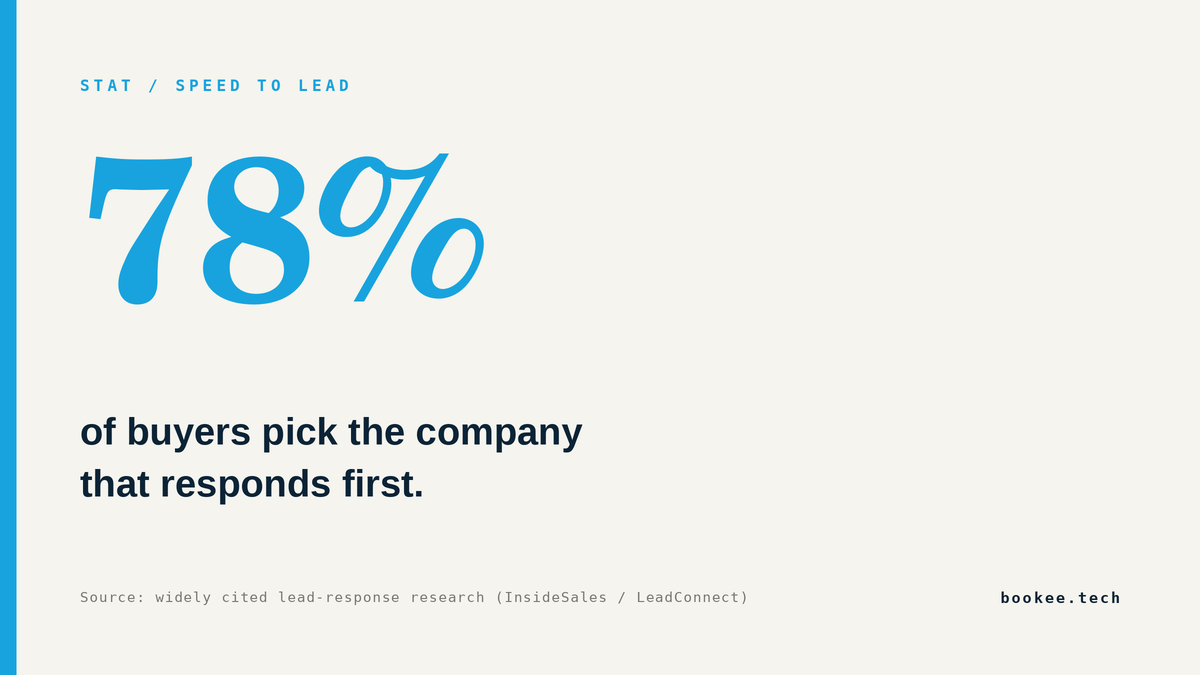
78% of buyers pick the company that responds first. Not the cheapest. Not the most credentialed. The first.
78% of buyers pick the company that responds first
Responding first proves you are reliable, anchors you as the default choice, and ends the lead's search before it really begins. You do not have to be better. You have to be there.
Why your team can't hit 60 seconds — and shouldn't have to
Here is the uncomfortable part. No human team reliably calls leads in 60 seconds. Not because they are lazy — because they are human. They are on another call, at lunch, asleep, or it is Saturday. Leads arrive at 9:14pm and 6:40am and during the one meeting nobody can leave. Staffing a person to pounce on every lead within a minute, all day, every day, does not pencil out for a small service business.
So the honest options are three: over-staff a phone team, accept that most leads go cold, or automate the first 60 seconds. That third option is why Bookee exists.
What 60 seconds actually looks like
This is the loop Bookee runs, untouched by human hands. A lead fills out your form. Within seconds, Bookee researches their business so the call is not generic, then places an outbound call in your own voice. It talks like a person, answers the obvious questions, finds a time that works, and books it straight onto your calendar — then sends the confirmation.
By the time you would normally be forwarding the lead to someone to follow up tomorrow, the meeting is already on the books. No new dashboard to babysit. No lead rotting in an inbox. The first touch happens before the lead has closed the tab.
The math is almost embarrassing
Run your own numbers. If you get 100 leads a month and book 20% of them today, slow response is quietly capping you. Closing even a handful more — because you were first, not best — is the difference between a flat month and a good one. The cost of being slow is not a missed call. It is the lifetime value of every customer who booked with whoever picked up first.
Speed to lead is the cheapest growth lever you have. You already paid for the lead. The only question left is whether you answer it in 60 seconds or 60 hours.